
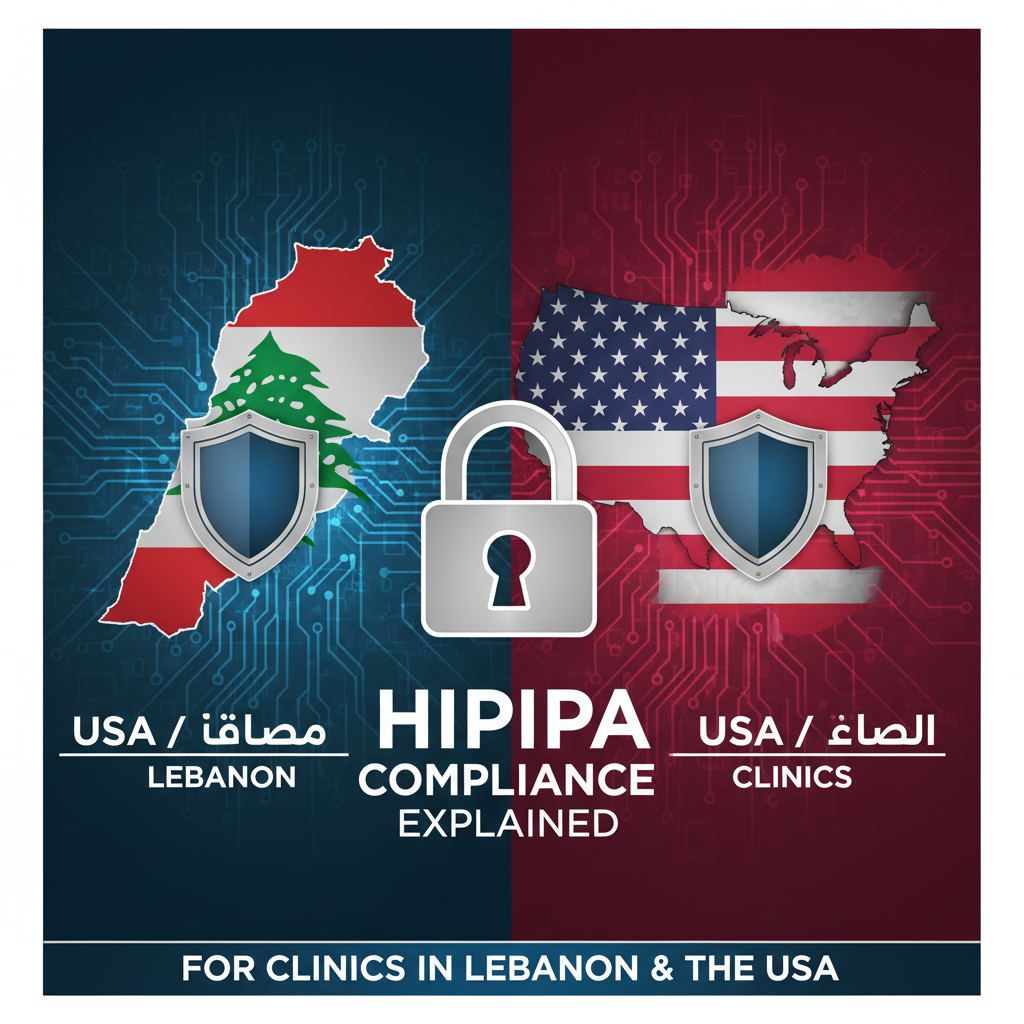
HIPAA Compliance Explained: A Crucial Guide for Clinics in Lebanon and the USA
In today’s interconnected world, safeguarding patient information is paramount. For healthcare clinics, understanding and adhering to data privacy regulations isn’t just a best practice; it’s a legal and ethical imperative. While the Health Insurance Portability and Accountability Act (HIPAA) is a US federal law, its principles and requirements hold significant implications for clinics, whether they operate in New York, Beirut, or anywhere else.
This comprehensive guide will demystify HIPAA compliance, detailing its core components and explaining why it’s indispensable for clinics in the USA, and critically, how it impacts clinics operating in Lebanon.
What Exactly is HIPAA?
The Health Insurance Portability and Accountability Act of 1996 (HIPAA) is a United States federal law that sets national standards to protect sensitive patient health information (PHI) from being disclosed without the patient’s consent or knowledge.
HIPAA is comprised of several key rules designed to ensure the confidentiality, integrity, and availability of PHI:
* **The Privacy Rule:** Sets standards for the protection of PHI, giving patients rights over their health information.
* **The Security Rule:** Establishes national standards for protecting electronic PHI (ePHI) through administrative, physical, and technical safeguards.
* **The Breach Notification Rule:** Requires covered entities and their business associates to notify affected individuals, the Department of Health and Human Services (HHS), and sometimes the media, following a breach of unsecured PHI.
* **The Omnibus Rule:** Strengthened the Privacy and Security Rules, making business associates directly liable for compliance and expanding patient rights.
Who Must Comply with HIPAA?
HIPAA mandates compliance from specific entities:
* **Covered Entities (CEs):** These include healthcare providers (like your clinic), health plans, and healthcare clearinghouses. If your clinic transmits health information electronically in connection with a HIPAA-covered transaction, you are likely a Covered Entity.
* **Business Associates (BAs):** Organizations or individuals who perform functions or activities on behalf of, or provide services to, a Covered Entity that involve the use or disclosure of PHI. This can include IT providers, billing companies, cloud storage providers, and more.
Why is HIPAA Compliance Crucial for Your Clinic?
Failing to comply with HIPAA can have severe consequences, impacting your clinic financially, legally, and reputationally:
* **Steep Penalties and Fines:** The HHS Office for Civil Rights (OCR) enforces HIPAA and can levy significant civil monetary penalties, ranging from thousands to millions of dollars per violation, depending on the level of negligence.
* **Legal Action and Criminal Charges:** In some cases of intentional misuse or unauthorized disclosure of PHI, criminal charges can be filed, leading to imprisonment.
* **Loss of Patient Trust:** A data breach or privacy violation can erode patient confidence, leading to a loss of patients and damage to your clinic’s reputation.
* **Operational Disruptions:** Investigations into non-compliance can be time-consuming and disruptive, diverting resources from patient care.
* **Increased Cyber Security Risk:** Non-compliance often indicates weaknesses in data security, making your clinic a prime target for cyberattacks and ransomware.
Key Pillars of HIPAA Compliance for Clinics
Achieving and maintaining HIPAA compliance requires a multifaceted approach:
* **Conduct Regular Risk Assessments:** Identify potential vulnerabilities and threats to the confidentiality, integrity, and availability of ePHI.
* **Develop & Implement Policies and Procedures:** Create clear, written guidelines for handling PHI, covering everything from access controls to incident response.
* **Staff Training:** Educate all employees on HIPAA regulations, your clinic’s policies, and their roles in protecting patient data. This should be ongoing.
* **Implement Robust Security Safeguards:**
* **Administrative:** Security management processes, workforce training, sanction policies.
* **Physical:** Facility access controls, workstation security, device and media controls.
* **Technical:** Access controls (unique user IDs, emergency access), audit controls, integrity controls, transmission security (encryption).
* **Business Associate Agreements (BAAs):** Ensure that any third-party vendor who handles PHI on your behalf signs a BAA, obligating them to protect the data according to HIPAA standards.
* **Incident Response Plan:** Have a clear plan for identifying, responding to, mitigating, and documenting security incidents and breaches.
HIPAA Compliance in the USA: A Direct Mandate
For clinics operating within the United States, HIPAA compliance is a direct legal obligation. Every aspect of patient interaction, data storage, billing, and communication must adhere to these federal standards. Regular audits, continuous staff education, and robust technological safeguards are not optional; they are foundational to operations. US clinics must be proactive in addressing new threats, updating software, and reviewing policies to remain compliant and avoid severe penalties.
HIPAA Compliance for Clinics in Lebanon: What You Need to Know
This is where it gets interesting for clinics in Lebanon. While HIPAA is a US law, it’s not exclusively limited to US soil. Lebanese clinics might find themselves needing to understand and potentially comply with HIPAA under certain circumstances:
* **Treating US Patients or Handling US Patient Data:** If your clinic in Lebanon treats patients who are US citizens or residents, and you electronically transmit their health information in connection with a transaction covered by HIPAA (e.g., for billing a US health plan), you may fall under HIPAA’s jurisdiction as a Covered Entity.
* **Business Associate to a US Covered Entity:** If your clinic provides services to a US-based hospital, clinic, or health plan that involves handling their patients’ PHI (e.g., remote diagnostic services, medical transcription), you would be considered a Business Associate and directly liable for HIPAA compliance.
* **International Collaborations:** Partnerships with US healthcare organizations or research institutions often come with contractual obligations to adhere to HIPAA standards, regardless of your physical location.
* **Best Practices and International Standards:** Even if not directly mandated, adopting HIPAA-like standards demonstrates a commitment to patient privacy and data security. This aligns with international data protection principles (like GDPR) and builds trust with a global patient base. It also positions your clinic favorably for future collaborations with US or international partners.
**Key takeaway for Lebanese Clinics:** Don’t assume HIPAA doesn’t apply to you. Evaluate your patient base, partnerships, and data handling practices. If there’s any link to US healthcare data or entities, a thorough understanding and implementation of HIPAA principles are crucial. Furthermore, prioritizing data privacy and security, irrespective of direct legal mandate, enhances your clinic’s reputation and protects your patients.
Steps to Achieve and Maintain HIPAA Compliance
Whether you’re in the US or Lebanon with ties to US healthcare, a structured approach is vital:
1. **Appoint a Privacy Officer and Security Officer:** Designate individuals responsible for overseeing compliance efforts.
2. **Conduct a Comprehensive Risk Assessment:** Identify where PHI resides and what risks it faces.
3. **Develop Written Policies & Procedures:** Document how your clinic handles PHI, from patient intake to data destruction.
4. **Implement Security Safeguards:** Deploy technical, physical, and administrative controls to protect ePHI.
5. **Train Your Workforce:** Ensure all staff understand their responsibilities regarding PHI.
6. **Execute Business Associate Agreements (BAAs):** Get written agreements from all vendors who access PHI.
7. **Regularly Monitor and Audit:** Continuously check systems and processes for compliance.
8. **Have a Breach Response Plan:** Know what to do if a data breach occurs.
9. **Review and Update Annually:** HIPAA requirements and threats evolve; your compliance efforts must too.
Partner for Peace of Mind
Navigating the complexities of HIPAA compliance can be challenging, especially when considering international implications. Protecting patient data is not just about avoiding penalties; it’s about upholding the trust that patients place in your care.
By prioritizing HIPAA compliance, clinics in both Lebanon and the USA demonstrate a strong commitment to ethical practice, data security, and patient well-being.
—
**Need expert guidance to ensure your clinic is fully HIPAA compliant? Contact us today for a comprehensive consultation and tailored solutions for your unique operational needs.**